
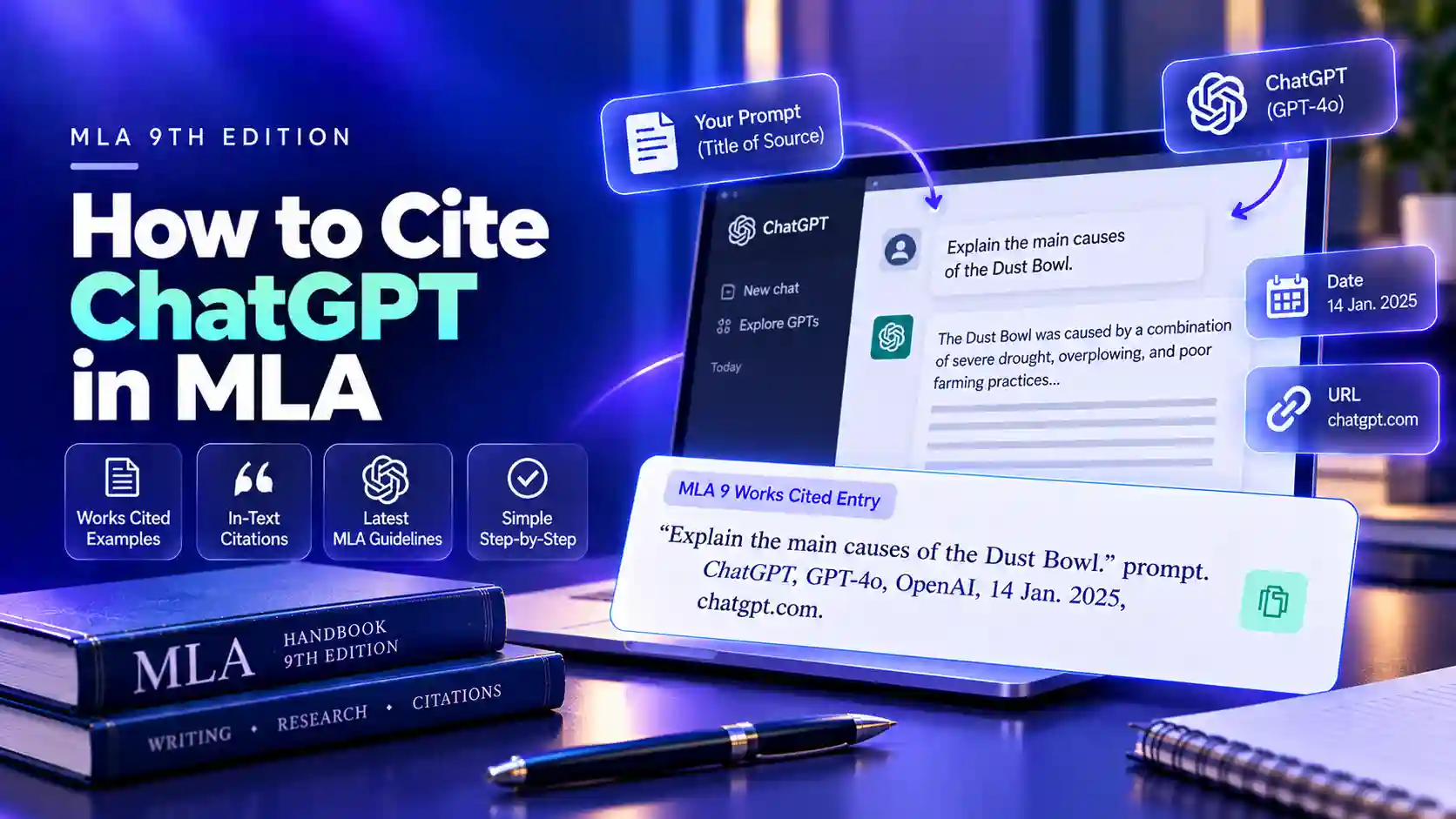
ChatGPT is never the author in MLA style. You cite it by describing the prompt you typed, then naming the tool, its version, the company behind it, the date, and the URL:
“Explain the main causes of the Dust Bowl” prompt. ChatGPT, GPT-4o, OpenAI, 14 Jan. 2025, chatgpt.com.
This pattern comes from the MLA Style Center's official guidance on generative AI, and it works the same for Claude, Gemini, Copilot, and image generators. Below you will find the template, ready-made examples, in-text citations, and the rules for when you must cite AI at all. Build the Works Cited entry automatically with our Works Cited Generator.
The MLA Template for AI-Generated Content
AI citations use the same core elements as any MLA 9 source. Some elements are simply left empty.
| Core Element | What to Write for AI | Example |
|---|---|---|
| Author | Leave blank; the tool is not an author | (none) |
| Title of source | Your prompt in quotation marks, followed by the word prompt | “Explain the main causes of the Dust Bowl” prompt. |
| Title of container | Name of the AI tool, in italics | ChatGPT, |
| Version | Model or version shown in the tool | GPT-4o, |
| Publisher | Company that makes the tool | OpenAI, |
| Date | Day you generated the content | 14 Jan. 2025, |
| Location | Shareable chat link, or the tool's general URL | chatgpt.com. |
Long prompts can be shortened to their key words in the title. If the tool creates a shareable link to your conversation, use it so readers can see the output; otherwise, the general URL is fine.
Works Cited Examples for Popular AI Tools
Swap in your own prompt, version, and date. The examples below are illustrative.
| AI Tool | MLA 9 Works Cited Entry |
|---|---|
| ChatGPT | “Summarize the themes of Of Mice and Men” prompt. ChatGPT, GPT-4o, OpenAI, 14 Jan. 2025, chatgpt.com. |
| Claude | “Compare solar and wind energy costs” prompt. Claude, Claude Sonnet 4, Anthropic, 3 June 2025, claude.ai. |
| Gemini | “List key events of the Civil Rights Movement” prompt. Gemini, 2.5 Flash, Google, 10 Sept. 2025, gemini.google.com. |
| Microsoft Copilot | “Explain how vaccines train the immune system” prompt. Copilot, Microsoft, 22 Feb. 2025, copilot.microsoft.com. |
| AI image generator | “Watercolor painting of a lighthouse at sunrise” prompt. DALL-E, version 3, OpenAI, 5 May 2025, openai.com/dall-e-3. |
If a tool does not display a version, as with the Copilot example, simply leave that element out. Titles of other works inside your prompt keep their own formatting, such as italics for a book.
How to Cite AI in Your Text
Since there is no author, the in-text citation uses a shortened version of your prompt, the first element of the Works Cited entry.
The drought and poor farming methods worked together to create the crisis (“Explain the main causes”).
Quote, parentheticalChatGPT described the region as “a perfect storm of drought and debt” (“Explain the main causes”).
NarrativeWhen asked to explain the causes of the Dust Bowl, ChatGPT pointed to drought, overplowing, and falling crop prices.
In a narrative citation, describing the prompt in your sentence is enough, so no parentheses are needed. Put any exact words from the AI in quotation marks, and use a block quotation if the passage runs longer than four lines. See MLA Block Quote Format for the indent and citation rules.
The MLA In-Text Citation Generator can shorten long prompts into a clean parenthetical for you.
When to Cite AI and When to Acknowledge It
MLA separates using AI content from using AI as a helper. The first needs a citation; the second needs an acknowledgment.
| How You Used AI | What MLA Expects |
|---|---|
| Quoted or paraphrased its answer | Works Cited entry and in-text citation |
| Included an AI-generated image, chart, or data | Works Cited entry and a caption citation |
| Used it to edit grammar, translate, or brainstorm | A short note explaining the use, such as a footnote |
| Found a source through it | Cite the original source you checked, not the AI |
A simple acknowledgment note might read: I used ChatGPT to suggest outline ideas for this essay; all writing and analysis are my own. Check your instructor's AI policy first, since some courses do not allow AI use at all.
Common Mistakes When Citing AI
| Mistake | Why It Is Wrong | Fix |
|---|---|---|
| Listing ChatGPT or OpenAI as the author | MLA does not treat AI tools as authors | Start the entry with your prompt |
| Citing the AI for a fact it pulled from elsewhere | AI tools can invent or misreport sources | Find the original source, verify it, and cite that |
| Leaving out the date | AI answers change between sessions | Add the day you generated the content |
| Forgetting the word prompt | Readers will not know the title is your question | Add prompt after the closing quotation mark |
| Using AI text without quotation marks | Copied wording counts as quoting | Quote it or paraphrase it, and cite it either way |
AI tools sometimes create convincing citations for articles that do not exist. Before you use any source an AI suggests, look it up yourself in a library database or search engine.
Final Check
Citing AI in MLA follows the same logic as any other source: describe what you used, name who made it, and say when you used it. The prompt takes the place of a title, and the company takes the place of a publisher.
Before submitting your paper, confirm every AI-generated idea or quotation has a matching Works Cited entry, and that you have verified any facts or sources the AI suggested along the way.
Ready to build your citation?
Try the free Works Cited Generator