
Free MLA Title Case Converter (MLA 9th Edition)
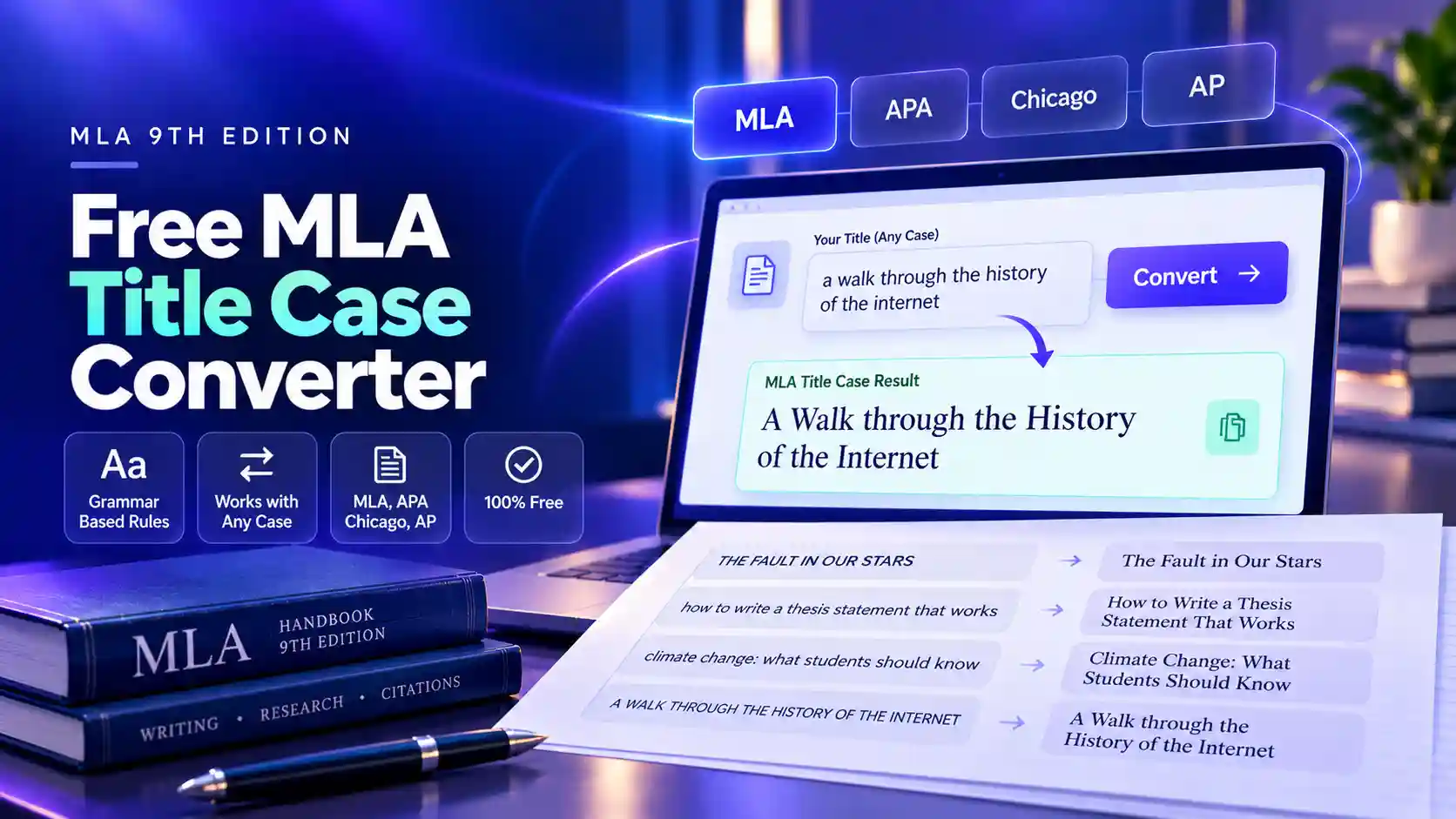
Our MLA title case converter capitalizes any title the way the MLA Handbook, 9th edition, requires. Paste your title, click convert, and get a correctly capitalized version for your essay, source titles, or Works Cited page.
The tool applies MLA's grammar-based rules automatically: major words are capitalized, and articles, prepositions, and coordinating conjunctions stay lowercase in the middle of a title. It works the same whether your text starts in all caps, all lowercase, or a messy mix.
How to Use the MLA Title Case Converter
Converting a title takes a few seconds.
- Paste or type your title. Any format works, including all caps, all lowercase, or sentence case.
- Keep MLA selected. Switch to APA, Chicago, or AP only if your assignment uses a different style.
- Read the live result. The tool capitalizes each word based on its role in the title as you type.
- Review names and acronyms. Check proper nouns, brand names, and terms like NASA or iPhone, since they keep their own spelling.
- Copy the result. Paste it into your essay, citation, or Works Cited Generator.
The converter only changes capitalization. It does not add italics or quotation marks, so apply those based on the source type, as explained below.
MLA Title Case Rules: What to Capitalize
MLA capitalization depends on a word's grammatical role, not its length. Capitalize the first word, the last word, and every principal word in between.
| Capitalize | Examples | Keep Lowercase (Mid-Title) | Examples |
|---|---|---|---|
| Nouns | Climate, Students | Articles | a, an, the |
| Pronouns | It, Our, Their | Prepositions of any length | of, in, through, between, about |
| Verbs, including short ones | Is, Are, Be, Was | Coordinating conjunctions | and, but, for, nor, or, so, yet |
| Adjectives | Hidden, Modern | The to in infinitives | to Read, to Be |
| Adverbs | Quickly, Not | — | — |
| Subordinating conjunctions | Because, If, When, That | — | — |
The lowercase words are capitalized when they come first, come last, or start a subtitle after a colon. MLA also asks you to apply these rules even when the original source capitalizes its title differently.
MLA Title Case Examples: Before and After
These conversions show how the converter handles the words students most often get wrong.
| You Type | MLA Title Case | Rule Applied |
|---|---|---|
| of mice and men | Of Mice and Men | First word always capitalized |
| a walk through the history of the internet | A Walk through the History of the Internet | Long prepositions stay lowercase |
| how to write a thesis statement that works | How to Write a Thesis Statement That Works | Infinitive to lowercase, That capitalized |
| THE FAULT IN OUR STARS | The Fault in Our Stars | All caps fixed, pronoun Our capitalized |
| climate change: what students should know about it | Climate Change: What Students Should Know about It | Subtitle capitalized, last word capitalized |
| why social media is changing the way we learn | Why Social Media Is Changing the Way We Learn | Short verb Is capitalized |
Notice that through and about stay lowercase. Many generic converters capitalize them because they follow APA or AP rules, which is a common reason for lost points in MLA papers.
Tricky Cases the Converter Handles
Some words change their capitalization depending on how they are used. Here is how MLA treats the common edge cases.
- Subtitles: capitalize the first word after the colon, even if it is an article or preposition. If the source separates the subtitle with a period or line break, use a colon in your citation.
- Hyphenated words: capitalize each part unless it is an article, preposition, or coordinating conjunction, as in Self-Made or Editor-in-Chief.
- Phrasal verbs: words like up, out, and off are capitalized when they act as part of a verb, as in Giving Up on Perfection.
- Proper nouns and acronyms: names, places, and acronyms keep their standard form, such as FBI or eBay.
- Poems titled by their first line: reproduce the line exactly as it appears in the source.
- Non-English titles: follow the capitalization rules of that language, not English title case.
- Ending punctuation: keep a question mark or exclamation point that is part of the original title.
Italics or Quotation Marks? Formatting Titles After Capitalizing
Once your title is capitalized, MLA asks you to style it based on the type of work. The rule is simple: complete works get italics, and parts of larger works get quotation marks.
| Style | Use For | Example |
|---|---|---|
| Italics | Books, films, TV series, websites, journals, magazines, newspapers, albums | The Great Gatsby |
| Quotation marks | Articles, book chapters, short stories, poems, songs, web pages, TV episodes | “The Road Not Taken” |
| Plain text | Your own essay title on page one | The Hidden Cost of Fast Fashion |
Your own paper title uses title case but no italics or quotation marks. Only add them when your title includes the name of another work. Place your converted title with the MLA Heading & Header Generator or the MLA Title Page Generator for a group project.
MLA vs. APA vs. Chicago vs. AP Title Case
All four styles capitalize the first word, the last word, and major words. The biggest difference is how they treat longer prepositions such as between, through, and with.
| Rule | MLA | APA | Chicago | AP |
|---|---|---|---|---|
| Prepositions of 4+ letters | Lowercase | Capitalize | Lowercase | Capitalize |
| Short verbs like Is and Be | Capitalize | Capitalize | Capitalize | Capitalize |
| Article and source titles in the reference list | Title case | Sentence case | Title case | Not a citation style |
| Example title | A Walk through the Past | A Walk Through the Past | A Walk through the Past | A Walk Through the Past |
So a title copied from an APA paper or a news site may look right but still break MLA rules. Run it through the converter with MLA selected before adding it to your Works Cited page. See MLA vs APA: Key Differences for the full comparison beyond title case.