
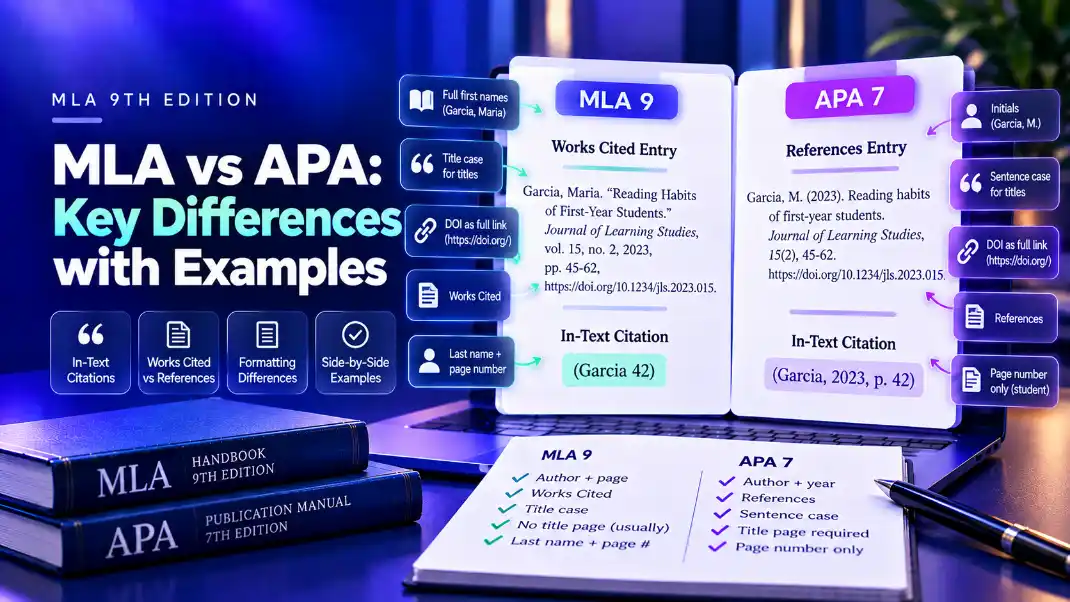
MLA and APA both credit your sources, but they put the spotlight on different things. MLA uses author and page, such as (Garcia 42), because humanities writing focuses on exact passages. APA uses author and year, such as (Garcia, 2023), because social science research depends on how current a study is.
This guide compares the current editions side by side: the MLA Handbook, 9th edition (2021), from the Modern Language Association, and the Publication Manual of the American Psychological Association, 7th edition (2019). Every rule below comes with an example you can copy. Build either style with the MLA Format Generator.
MLA vs APA at a Glance
| Feature | MLA 9 | APA 7 |
|---|---|---|
| Main fields | English, literature, languages, arts, philosophy | Psychology, education, nursing, business, sociology |
| In-text citation | (Garcia 42) | (Garcia, 2023, p. 42) |
| Source list title | Works Cited | References |
| Author names in list | Full first name: Garcia, Maria | Initials: Garcia, M. |
| Date position | Near the end of the entry | Right after the author |
| Source title capitalization | Title case | Sentence case for articles and books |
| Title page | Not required | Required |
| Page header | Last name and page number | Page number only for student papers |
Both styles share the basics: double spacing, 1-inch margins, a half-inch hanging indent in the source list, and alphabetical order by author.
In-Text Citations: MLA vs APA
The in-text citation is where students mix up the two styles most. MLA never includes the year and never uses a comma or p. before the page. APA always includes the year, separated by commas.
| Situation | MLA 9 | APA 7 |
|---|---|---|
| One author, quote | (Garcia 42) | (Garcia, 2023, p. 42) |
| One author, paraphrase | (Garcia 42) | (Garcia, 2023) |
| Two authors | (Garcia and Lee 42) | (Garcia & Lee, 2023, p. 42) |
| Three or more authors | (Garcia et al. 42) | (Garcia et al., 2023, p. 42) |
| Author named in sentence | Garcia argues ... (42). | Garcia (2023) argues ... (p. 42). |
| No author | (“Rising Sea Levels” 3) | (“Rising Sea Levels,” 2023) |
Two details trip people up. APA uses an ampersand inside parentheses but writes “and” in a sentence. APA also suggests a page number for paraphrases, but only requires one for direct quotes, while MLA includes it whenever the source has page numbers.
Need a quick MLA version? The MLA In-Text Citation Generator builds it from the author and page.
Works Cited vs References: Entry Examples
The same source looks noticeably different in each list. Compare the author format, date position, and capitalization in these entries. The journal and website examples are illustrative.
| Source | MLA 9 Works Cited | APA 7 References |
|---|---|---|
| Book | Clear, James. Atomic Habits: An Easy & Proven Way to Build Good Habits & Break Bad Ones. Avery, 2018. | Clear, J. (2018). Atomic habits: An easy & proven way to build good habits & break bad ones. Avery. |
| Journal article | Garcia, Maria, and Daniel Lee. “Remote Learning and Student Motivation.” Journal of Learning Studies, vol. 15, no. 2, 2023, pp. 45-62, https://doi.org/10.1234/jls.2023.015. | Garcia, M., & Lee, D. (2023). Remote learning and student motivation. Journal of Learning Studies, 15(2), 45-62. https://doi.org/10.1234/jls.2023.015 |
| Web page | Patel, Ravi. “How Sleep Affects Memory.” Health Daily, 12 Mar. 2024, www.healthdaily.com/sleep-memory. | Patel, R. (2024, March 12). How sleep affects memory. Health Daily. https://www.healthdaily.com/sleep-memory |
Notice three patterns. MLA puts article titles in quotation marks, while APA leaves them plain. MLA labels volume and issue as vol. and no., while APA italicizes the volume and puts the issue in parentheses. MLA drops https:// from plain URLs, but both styles write DOIs as full https://doi.org/ links — a format MLA adopted in its 9th edition; see MLA 8 vs MLA 9 for what else changed. Build the MLA side with the Works Cited Generator.
Paper Format Differences
Beyond citations, the two styles set up the paper itself differently.
| Element | MLA 9 | APA 7 (Student Paper) |
|---|---|---|
| First page | Four-line heading at top left, title centered below | Separate title page with bold, centered title |
| Page header | Last name and page number, top right | Page number only, top right |
| Abstract | Not used | Only if your instructor requires it |
| Section headings | No set levels, keep them consistent | Five defined heading levels |
| Block quotes | More than four lines of prose | 40 words or more |
| Fonts | Any readable font, 11 to 13 points | Options such as 12-point Times New Roman or 11-point Calibri |
The title page is the fastest giveaway. A paper that opens with a centered cover page is almost always APA, while one that starts with a name block at the top left is MLA.
Which Style Should You Use?
Your assignment sheet always comes first. When it does not name a style, your subject usually decides it.
| Use MLA For | Use APA For |
|---|---|
| English and literature essays | Psychology research papers |
| Foreign language courses | Education and teaching courses |
| Art, film, and music analysis | Nursing and health sciences |
| Philosophy and religious studies | Business and economics reports |
| Cultural and media studies | Sociology and criminal justice |
History is the main exception. Many history courses use Chicago style instead of either one, so confirm with your instructor.
Switching from MLA to APA (or Back): A Quick Checklist
Converting a finished paper is mostly a find-and-fix job. Work through these changes in order.
- Rename the source list. Works Cited becomes References, or the reverse.
- Rewrite author names. Switch between full first names (MLA) and initials (APA).
- Move the date. APA puts the year in parentheses after the author; MLA moves it near the end.
- Recase the titles. APA uses sentence case for article and book titles; MLA uses title case for all.
- Update every in-text citation. Add or remove the year, commas, and p.
- Rebuild the first page. Add an APA title page, or replace it with the MLA four-line heading.
- Fix the page header. Page number only for APA student papers; last name and page number for MLA.
The citation builder on the MLA Format Generator supports both MLA 9 and APA 7, so you can switch styles for each source instead of retyping entries by hand.
Ready to build your citation?
Try the free citation generator