
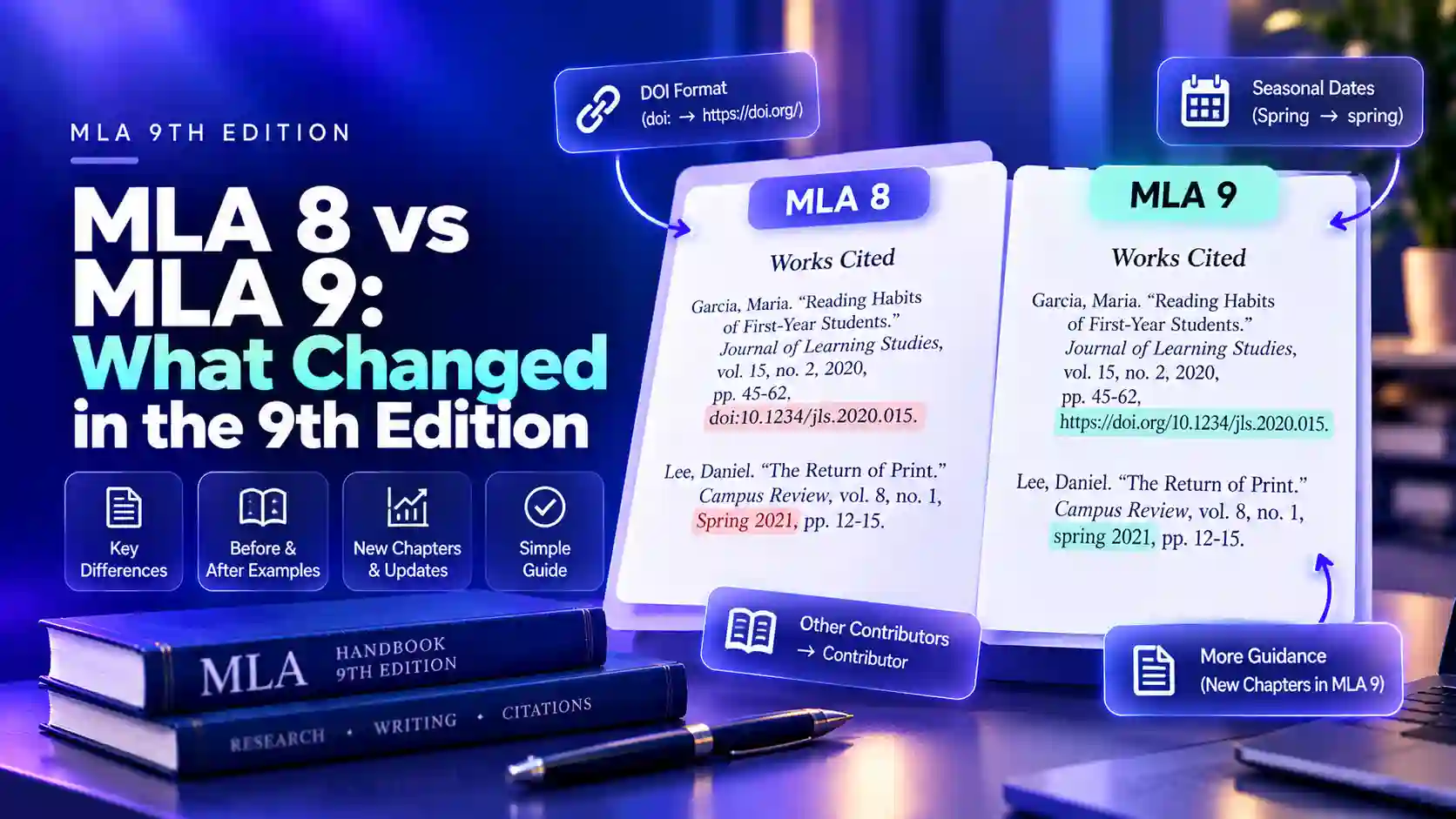
Less changed between MLA 8 and MLA 9 than most students expect. The MLA Handbook, 9th edition, released in April 2021, kept the same core elements system from the 8th edition (2016). What it added was detail: clearer rules for DOIs and publication cities, a renamed element, and new chapters on paper formatting, inclusive language, notes, and annotated bibliographies.
This guide shows exactly which rules changed, which stayed the same, and what that means for the citations in your next paper. Build an MLA 9 citation now with the Works Cited Generator.
What Stayed the Same
The biggest shift in MLA history happened in the 8th edition, when separate rules for each source type were replaced by one flexible template. MLA 9 keeps that template. Every Works Cited entry is still built from nine core elements, in this order:
- Author
- Title of source
- Title of container
- Contributor
- Version
- Number
- Publisher
- Publication date
- Location
These rules also carry over unchanged: author and page in-text citations, et al. for three or more authors, a second container for sources found in databases, and the preference for a DOI over a URL when both exist. If you learned MLA 8, your citations are already mostly right. Build either kind with the MLA In-Text Citation Generator.
Key Citation Changes: MLA 8 vs MLA 9
These are the rule changes that affect what your Works Cited entries actually look like.
| Rule | MLA 8 | MLA 9 |
|---|---|---|
| DOI format | Prefixed with doi: | Written as a full https://doi.org/ link |
| Fourth core element | Other contributors | Renamed Contributor |
| City of publication | Generally dropped | Included only in specific cases (see below) |
| Seasons in dates | Capitalized, such as Spring 2020 | Lowercase, such as spring 2020 |
| Long URLs | Little guidance | May be shortened to the site; avoid link shorteners like bit.ly |
| Annotated bibliographies | No formal format | Defined format, with annotations indented one inch |
| Font size | Readable font | Readable font, 11 to 13 points |
For the city of publication, MLA 9 asks you to add it only when a book was published before 1900, when the publisher has offices in more than one country, or when the publisher is unknown in North America. For most modern US books, you still leave it out.
New Chapters and Expanded Guidance
Most of what is new in MLA 9 is extra guidance rather than new rules. The handbook is more than twice the length of the 8th edition, with hundreds of added examples.
| New in MLA 9 | What It Covers | Why It Matters to Students |
|---|---|---|
| Paper formatting chapter | Heading, margins, spacing, running head, title pages for group projects | Formatting rules are back in the handbook after MLA 8 left them out |
| Inclusive language chapter | Writing respectfully about race, ethnicity, gender, sexual orientation, disability, age, and social status | Your word choices, not just citations, follow MLA guidance |
| Mechanics chapters | Punctuation, italics, capitalization, numbers, abbreviations, quotations | One source for style questions instead of guessing |
| Notes chapter | When to use footnotes and endnotes | Clarifies that notes add comments, not replace in-text citations |
| Annotated bibliographies | Title options, layout, and annotation placement | A clear standard for a common assignment |
| Digital sources | Apps, databases, social media, and online-only works | More examples for the sources students cite most today |
The in-text citation and plagiarism sections were also expanded with clearer explanations, but the basic author and page pattern did not change.
Before and After: Citation Examples
The differences are small, but graders who know MLA 9 will notice them. These entries are illustrative.
Journal article with a DOI
Garcia, Maria. “Reading Habits of First-Year Students.” Journal of Learning Studies, vol. 15, no. 2, 2020, pp. 45-62. doi:10.1234/jls.2020.015.
MLA 9Garcia, Maria. “Reading Habits of First-Year Students.” Journal of Learning Studies, vol. 15, no. 2, 2020, pp. 45-62, https://doi.org/10.1234/jls.2020.015.
Seasonal issue of a magazine
Lee, Daniel. “The Return of Print.” Campus Review, vol. 8, no. 1, Spring 2021, pp. 12-15.
MLA 9Lee, Daniel. “The Return of Print.” Campus Review, vol. 8, no. 1, spring 2021, pp. 12-15.
In both cases, the author, titles, container, and numbers stay exactly where they were. Only the DOI form and the season's capitalization change.
How to Tell If a Citation Generator Uses MLA 9
Many older templates and citation tools still output MLA 8 without saying so. Run one test citation and check these signs.
- DOIs appear as https://doi.org/ links, not doi: prefixes.
- The tool lists the fourth element as Contributor.
- Seasons such as spring or fall are lowercase in dates.
- City of publication is left out for modern books unless one of the MLA 9 exceptions applies.
- An access date is offered for online sources with no publication date.
- The tool says MLA 9 or ninth edition, not just MLA.
The MLA Format Generator builds citations to MLA 9 rules for 16 source types and also formats the paper itself, following the handbook's returned formatting chapter. Whatever tool you use, compare at least one result against these points before you trust the rest. If you're also weighing which citation style to use, see MLA vs APA: Key Differences.
Ready to build your citation?
Try the free Works Cited Generator